The Last House 2026 Ending Explained: Full Netflix Movie Climax Breakdown and Hidden Secrets
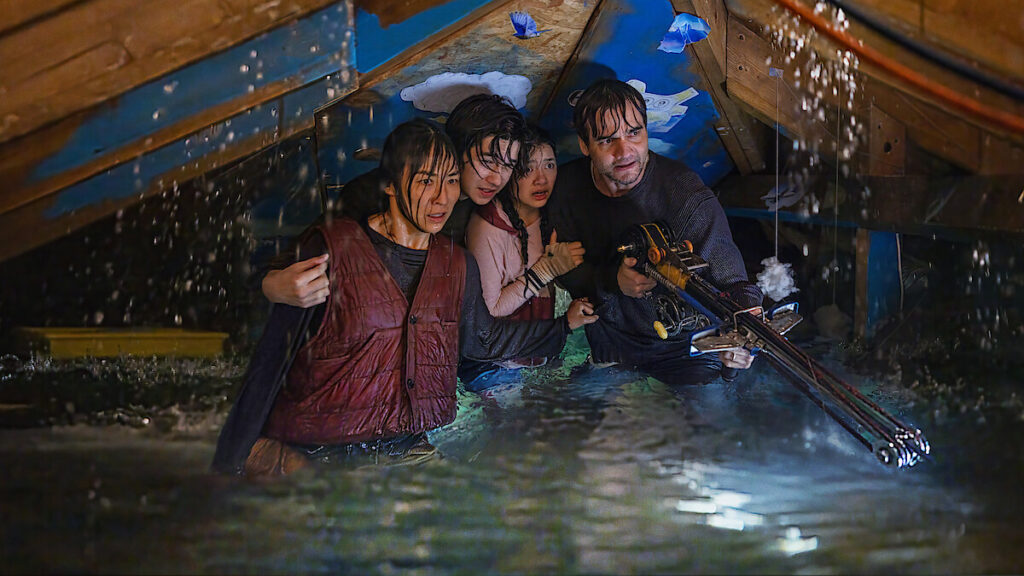
Photo by Chris Baker / Netflix
The global cinematic landscape in August 2026 has been completely taken over by a new psychological sci-fi horror masterpiece. If you have recently browsed your Netflix queue or kept a sharp eye on trending releases, you already know that The Last House 2026 has become an overnight viral sensation. In this ultimate guide to The Last House 2026 Ending Explained, we will deep dive into how this movie directed with clinical precision by Louis Leterrier and powered by emotional performances from Greta Lee and Wagner Moura left audiences stunned.
The premise seems deceptively simple at first: a regular family finds themselves inexplicably locked inside their own high-tech suburban home. However, as the plot unfolds, the narrative spirals into a mind-bending, reality-warping disaster that subverts every single trope of the home-invasion and apocalyptic genres. If the chaotic, tension-fueled climax left you with more questions than answers, you are certainly not alone. In this ultimate breakdown, we are going to unpack the film’s deepest secrets, decode the true nature of the external threat, and examine the hidden meanings buried within the final frames.
The Last House (2026) Movie Overview & Cast Details
Before we dive deep into the micro-details of the plot holes, character fates, and thematic symbols, let us lay down the core structural facts of this survival thriller. This quick-reference guide sets up the essential production and character details you need to know.
| Movie Attribute | Official Production Details & Fact Sheet |
| Movie Title | The Last House (2026) |
| Director | Louis Leterrier |
| Primary Genre | Sci-Fi / Psychological Horror / Survival Thriller |
| Release Date | August 7, 2026 (Global Netflix Release) |
| Lead Actress | Greta Lee (playing the mother, Ann Delgado) |
| Lead Actor | Wagner Moura (playing the father, Jason Delgado) |
| The Delgado Children | Graham Delgado and Ruth Delgado |
| Key Cinematic Inspirations | Jaws, Alien, and The Thing (Practical creature designs) |
| Core Streaming Platform | Available globally on Official Netflix Streaming Page |
What Happened to the Delgado Family? The Last House Plot Setup
To truly comprehend the terrifying implications of the finale, we must first dissect the intricate timeline established in the first half of the film. The story centers on the Delgado family—Ann, her husband Jason, and their two children, Graham Delgado and Ruth Delgado. They live in a highly advanced, automated smart home nestled in an isolated suburban valley.
The horror begins not with a typical jump-scare, but with a subtle atmospheric shift. What is initially reported on the news as a localized storm quickly mutates into something far more sinister. Within hours, the internet goes completely dark, cell towers lose power, and a strange, relentless saltwater rain begins to fall from a pitch-black sky.
Before the family can process the severity of the situation, the house’s automated defense grid receives a corrupted external signal. In an instant, the smart home enters an irreversible automated lockdown. Heavy, military-grade steel shutters seal every single window, reinforced titanium deadbolts lock the doors, and the family is trapped inside a luxurious, soundproof cage. The tragedy of the film lies in this exact paradox: the very system designed to protect them becomes their claustrophobic prison, cutting them off from a world that is actively dying outside.
How Did the Delgado Family Survive Inside the Five-Year Confinement?
One of the biggest talking points and structural milestones in the script is the five-year confinement. The movie takes a massive chronological leap, showing how a temporary lockdown stretches into a multi-year psychological battle for survival. Trapped inside a sinking, flooded home with diminishing resources, the house becomes an echo chamber of desperation.
- Phase 1: Initial Atmospheric Storm & Corrupted Signal Lockdown
- Phase 2: Five Years of Total Isolation and Resource Management
- Phase 3: Rations Depleted, Sickness Arrives, and Foundation Rotting
- Phase 4: The Desperate Basement Drainage and Sewer System Escape
How did they survive for five long years? The smart home’s basement initially contained emergency rations meant to last for months, supplemented by advanced water-filtration systems connected to the home’s solar grid. However, as the relentless saltwater rain continued to pound the structure, the foundation began to rot, and rising water levels slowly contaminated their subterranean storage rooms.
By the fifth year, their supplies are completely ruined. The family is thin, pale, and suffering from extreme isolation. The true breaking point occurs when the mother, Ann, contracts a severe respiratory infection due to the stagnant, recycling air inside the sealed house. With the automated system refusing to unlock the doors, the family realizes that staying inside no longer means safety—it means slow, quiet extinction.
How Did the Sewer Run Help the Delgado Family Find Antibiotics?
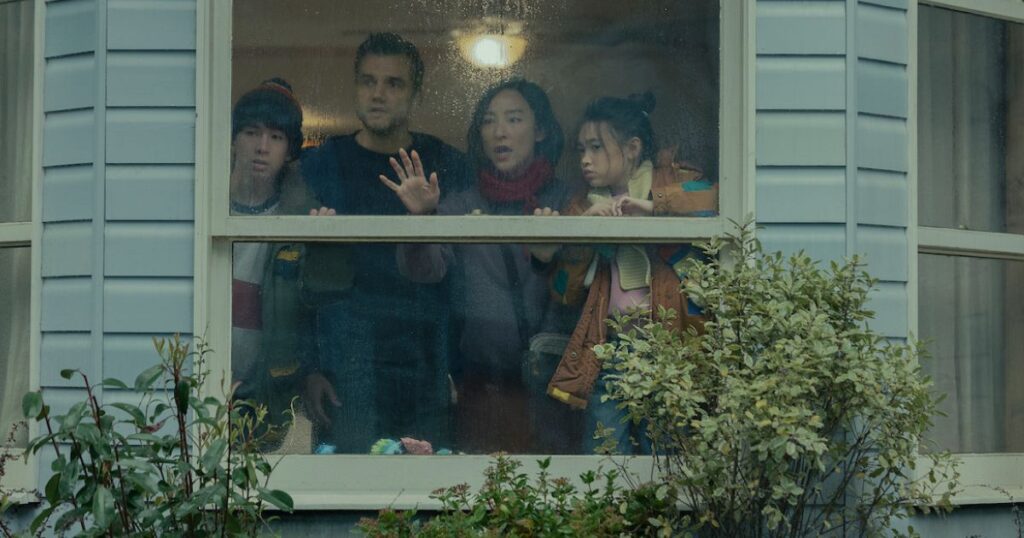
With Ann on the verge of death, the family is forced to look for alternative exit points that bypass the main security shutters. Jason discovers that the house’s automated drainage and sewage tunnels beneath the basement are the only pathways not completely reinforced with steel gates. This triggers the high-stakes sequence known to fans as the Sewer Run.
Jason and the teenage daughter, Ruth, venture into the dark, flooded crawlspaces beneath the concrete foundation. Their objective is clear but incredibly dangerous: navigate the interconnected suburban pipe network to reach a neighbor’s abandoned house, which they believe contains life-saving heart medication and antibiotics.
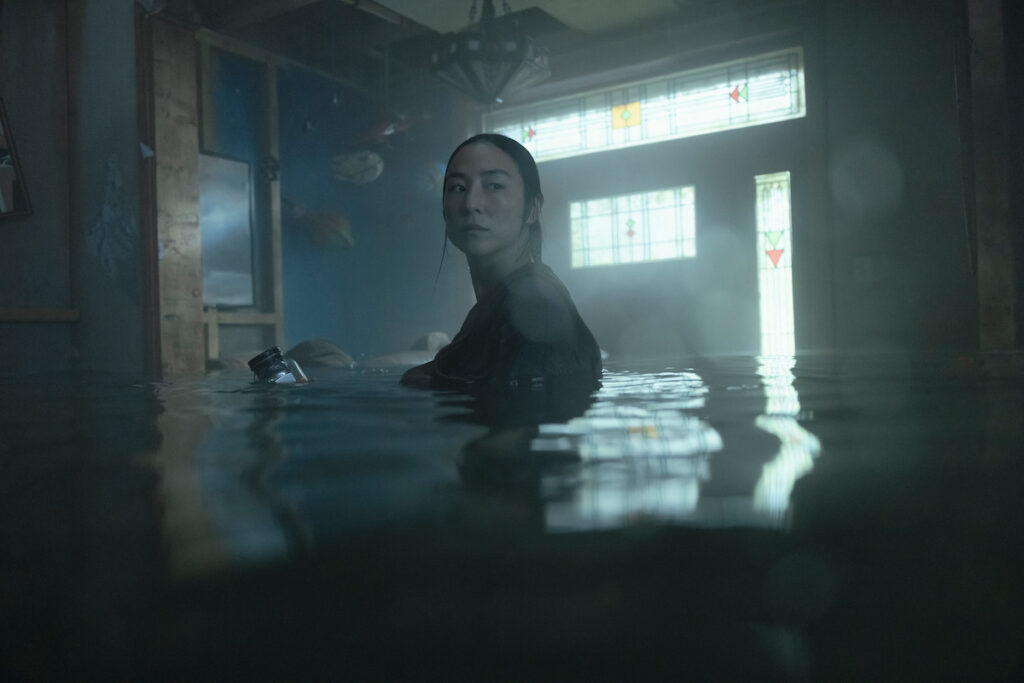
The sequence is a masterclass in claustrophobic horror. Crawling through freezing, muddy saltwater, Jason and Ruth realize that the subterranean world is no longer empty. The floodwaters within the pipes are moving against natural gravity, pulled by an unnatural current. It is during this desperate journey that the family catches their first close-up glimpse of the terrifying entities controlling the ecosystem outside.
How Did Jason Capture the Monster in the Attic Trap?
Tired of merely surviving inside their sinking, flooded home and desperate to find a way to force the house to open, Jason devises a dangerous plan. If they cannot break through the steel doors, they must trick the house’s external environmental sensors into believing the threat outside is gone. To do this, they need to capture one of the organisms roaming the flooded property.
Using a structural flaw near the upper roof where the synthetic rain had partially eroded the plaster, the family rigs elaborate traps in the highest room of the house. They create a pathway leading from the roof directly into the attic, using a small source of warmth and light as bait. The plan works, but it results in a terrifying confrontation: a live, frantic creature slips through the opening and becomes trapped inside the Attic Trap.
Jason immediately rushes to the attic armed with a heavy harpoon weapon, preparing to kill the thrashing entity out of sheer fear and survival instinct. He believes that by destroying the creature, he can study its anatomy or use its physical mass to trigger the pressure sensors on the emergency exits. However, this moment of violence is abruptly halted by a surprising source.
What Happened to Cassidy the Dog in The Last House?

To understand the emotional weight of the attic scene, we must address one of the saddest elements of the film’s background lore: the tragic fate of Cassidy, the family’s elderly golden retriever. Throughout the first few years of the confinement, Cassidy remained a symbol of hope and normal life for the children, Graham and Ruth.
However, as resources dwindled during the multi-year lockdown, Cassidy ran out of his essential daily heart medication. The dog began to suffer from severe, agonizing respiratory failure due to the stale air and damp conditions. Unable to watch the animal suffer any longer, Jason had to make a grim, heart-breaking decision. While the rest of the family was ushered into another room, Jason performed a painful mercy killing, putting the loyal dog down with a gun to end his torment.
The tragedy grew even darker as survival conditions grew increasingly dire. With food supplies entirely exhausted in the fourth year, the family was forced to place Cassidy’s body in the kitchen freezer to preserve it as potential food. Though they never actually resorted to consuming their beloved pet, the psychological scar of keeping Cassidy in the freezer haunted Jason and the children. This deep-seated guilt directly influences how the family reacts when they face the trapped creature in the attic.
What Are the Monsters? The Primordial Ocean Dwellers Explained
When Jason stands in the attic with his harpoon raised, the audience finally gets a clear view of the antagonist. These creatures are not mindless space monsters or alien invaders. The film presents a massive twist regarding their origin and biological purpose.
- Ancient Earth Origins: These entities are primordial ocean dwellers. They are an ancient, deep-sea species that has lived on Earth far longer than humanity itself. They are the original inhabitants of the planet.
- Driven by Human Pollution: For centuries, these creatures slept in the deepest trenches of the ocean. However, modern human pollution, industrial waste, and global warming began “boiling the oceans,” destroying their native habitat and forcing them to emerge from the deep.
- Weather Manipulation: They do not use mechanical technology. Instead, they possess the biological power to manipulate water, summon relentless saltwater rain, and project an invisible atmospheric force that triggers electronic smart grids, trapping humans inside their own homes.
- The Creatures’ Perspective: From their point of view, humans are the destructive invaders who damaged the earth. By locking people inside their houses, the creatures are not trying to actively hunt them; they are trying to starve out human civilization to allow nature, oceans, and wildlife to flourish without human interference.
Director Louis Leterrier noted in production interviews that their practical, tentacled designs drew heavy inspiration from classic creature features like Jaws, Alien, and The Thing, focusing on wet, organic textures that emphasize their deep-sea nature.
Why Did Ruth Show an Act of Mercy to the Creature?
As the trapped deep-sea creature thrashes in the attic, Jason raises his harpoon to impale it. But just before he can strike, his young daughter, Ruth, steps between her father and the creature. Having witnessed the painful loss of their dog Cassidy, Ruth refuses to allow more mindless violence to enter their home.
Ruth begs her father to show mercy. She looks closely at the creature and realizes it is not acting out of malice or evil intentions; it is trapped, terrified, and suffocating in the dry air of the attic, echoing the exact structural confinement the human family has endured for five years. She extends her hand in a gesture of pure empathy and compassion.
This Act of Mercy breaks the cycle of hostility between the two species. The creature senses that the young girl understands its plight—that humans are finally recognizing their role in destroying the planet’s balance. When Jason slowly puts his weapon down and helps Ruth open a ventilation valve to let fresh rainwater soothe the creature, the entity stops its aggressive clicking sounds.
The Last House 2026 Ending Explained: The Climax Breakdown
The final twenty minutes of the film deliver a rapid, breathtaking resolution that connects all the thematic elements of survival and environmental commentary. Once the trapped creature is showing mercy, the entire dynamic of the global lockdown changes.
Why Did the Supernatural Rain Stop After the Attic Standoff?
The freed creature uses its bio-sonic frequencies to send a massive signal to the swarm of outside monsters waiting in the flooded streets. Recognizing the family’s act of compassion over violence, the outside entities decide to spare the Delgado family. In an instant, the supernatural environmental barriers disappear. The relentless, five-year-long saltwater rain finally stops, and the thick black clouds part to reveal the sun for the first time in half a decade.
Why Did the High-Tech Smart House Structurally Collapse?
As the external atmospheric pressure shifts rapidly, the rotted, waterlogged foundation of the smart home cannot handle the sudden change. The ruined house begins to buckle and structurally collapse. Jason, Ann, Graham, and Ruth scramble through the opening shutters just as their high-tech prison sinks entirely into the earth, symbolizing the complete destruction of humanity’s artificial isolation from nature.
Where Does the Delgado Family Sail to on the Boat Cassidy?
The family steps out into a completely transformed world. The entire suburban valley has been replaced by a quiet, endless, flooded landscape. The old world is gone, buried beneath a beautiful, clean oceanic tide. To survive, the family takes a neighbor’s abandoned boat to sail out into the open water. In a beautiful nod to their past trauma and emotional survival, the family decides to rename the boat Cassidy, honoring the memory of the loyal golden retriever who didn’t make it to the new world.
Who Responded to the Radio Signal at the End of the Movie?
As the film prepares to cut to the final credits, Louis Leterrier leaves the audience with one last chilling yet hopeful puzzle piece. While sailing out into the flooded world looking for signs of dry land or human life, the mother, Ann, spends hours tinkering with an old, battery-operated emergency radio transmitter.
She sends a desperate, repeating transmission into the static: “Is anyone out there? This is the Delgado family. We survive.”
For several long, agonizing moments, there is nothing but white noise and empty static, emphasizing the vast isolation of the new world. But just before the screen fades to black, a faint, crackly, and heavily distorted voice cuts through the speaker, uttering a single, short response: “Hello?”
This Radio Signal twist provides massive answers for the audience. It officially confirms that the Delgado family are not the only human survivors left on Earth. Other small pockets of humanity managed to endure the five-year confinement within their respective shelters. While the era of human dominance and industrial pollution has permanently ended, this final voice provides a hopeful note that humanity can still find a way to coexist, rebuild, and start over within this new global ecosystem.
What Are the Biggest Plot Holes and Flaws in The Last House?
While the movie is an undeniable triumph of tension and atmosphere on Netflix, cinema critics and fans on movie forums have pointed out a few prominent narrative flaws and structural plot holes that stretch the boundaries of realism.
- The Logistics of the Five-Year Confinement: Many viewers find the survival mechanics a bit too easy and unrealistic given the extreme duration of the lockdown. Surviving for five years inside a single suburban home without an active agricultural setup or consistent canned food supplies strains narrative plausibility.
- The Sickness Timing: The mother’s severe respiratory illness conveniently peaks exactly at the five-year mark to drive the third-act tension, rather than developing earlier during the years of breathing recycled, damp air.
- The CGI Climax Quality: While the first two acts rely heavily on grounded acting and practical effects inspired by Alien, the final sequence showing the house collapsing and the creatures moving away shifts toward somewhat messy, low-stakes CGI work that reduces the impact of the final standoff.
Despite these minor script inconsistencies, the film remains an incredibly compelling, thought-provoking watch that successfully balances intense psychological horror with a meaningful message about environmental responsibility and empathy.
If you love deep cinematic breakdowns, don’t miss our ultimate guide on Spider-Man Brand New Day Ending Explained: Full Movie Breakdown.
Frequently Asked Questions (FAQs)
Why did the doors and windows seal in The Last House?
The automated smart home entered an irreversible lockdown because its advanced safety system received a corrupted external signal caused by the anomalous saltwater rain. The house was programmed to protect the occupants from atmospheric disasters, but it miscalculated the length of the crisis, turning a protective shield into a permanent five-year prison.
Does the dog Cassidy survive in the movie?
No, the dog Cassidy does not survive the five-year confinement. The elderly golden retriever ran out of his daily heart medication and suffered from severe breathing trouble due to the stale air inside the sealed house. To end his painful suffering, the father, Jason, had to perform a heart-breaking mercy killing with a gun.
What are the creatures in The Last House 2026?
The mysterious entities are not aliens or extraterrestrial invaders; they are primordial ocean dwellers who lived on Earth long before humans. They emerged from the deep oceans because human industrial pollution and global warming began “boiling the oceans” and destroying their ancient ecosystem.
Who survives at the end of The Last House?
All four members of the Delgado family—Ann, Jason, Graham, and Ruth—successfully survive the terrifying five-year ordeal. They manage to escape through the subterranean drainage network just before their waterlogged smart home structurally collapses into the mud.
What is the meaning behind the radio signal at the end?
The crackly “Hello?” response heard over the emergency radio transmitter officially confirms that the Delgado family are not the only human survivors on Earth. It proves that other small pockets of humanity managed to outlast the lockdown in their respective shelters, leaving a hopeful note for the future of human coexistence.
The Last House 2026: Conclusion
In the end, The Last House (2026) uses its sci-fi premise to deliver a profound commentary on human entitlement and modern isolation. The film forces us to look at our relationship with the planet, showing that real survival requires us to drop our weapons, face our past losses like Cassidy, and learn to coexist with the natural world rather than trying to conquer it. It is a brilliant, terrifying ride that will keep audiences talking for years to come.

I am a Professional movie blogger and SEO writer at StartlightNovels.com, dedicated to creating in-depth movie reviews, breakdowns, and entertainment content with clear and user-friendly explanations.